Functional Nutrition Is a Value System: Food, Exercise, Mindset
by MILESTONE® Food for Your Genes
Introduction: Functional Nutrition Is a Value System
We don’t treat health as something you “buy.” We treat it as something you practice — daily — through food, movement, and mindset.That’s what functional nutrition means to us. Not a trend. Not a strict diet. Not a longevity promise. A value system built around how human biology actually works: complex, adaptive, and deeply individual.
Modern life nudges us toward the opposite. Convenience replaces real nourishment. Movement becomes optional. The nervous system rarely downshifts. And when results don’t come, we often reach for stronger “solutions” instead of changing the signals that biology listens to.
If we had to name only three signals that matter most, they would be:
- Functional foods rich in natural bioactives, minerals, and vitamins
- Daily exercise as an irreplaceable “natural prescription”
- Mindset shaped by meaning, calm, and connection to nature
In this cornerstone guide, we’ll explain why these three aren’t just habits. They’re values — and why we built MILESTONE® to stand for all of them.
What Functional Nutrition Means
Most people think functional nutrition means “healthy eating.”
But functional nutrition is more specific than that. It’s not just about avoiding bad foods — it’s about choosing inputs that still carry biological intelligence: minerals, vitamins, enzymes, and bioactive phenolic compounds that act like signals, not just calories.
Modern food often fails here — not because it has “no nutrients,” but because so much of what we eat is designed for yield, shelf-life, and convenience. The result is food that fills the stomach but doesn’t reliably engage the systems that regulate energy, inflammation, and metabolic balance.
That’s why functional nutrition isn’t a diet. It’s a way of thinking:
- Food is information: real foods don’t just “contain” nutrients — they carry co-factors and structures that shape how those nutrients behave in the body.
- Matrix matters: nutrients delivered inside a natural food matrix are absorbed, metabolized, and used differently than isolated powders in capsules.
- Nutrient density matters: it’s not how much you eat — it’s how much essential nutrition you get per bite.
Functional nutrition also respects individuality. Two people can eat the same meal and get different responses, because digestion, microbiome function, stress tone, and genetics shape the outcome. So our goal isn’t to promise the same result for everyone.
Our goal is simpler — and more honest:
to improve the quality of the daily signals your body receives, so biology has the conditions to respond.

Why Modern Food Doesn’t “Act Like Food” Anymore
Most people aren’t “undernourished” because they don’t eat enough.
They’re under-supported because modern food often delivers calories without signals.
When food is heavily refined and ultra-processed, we don’t just change taste and shelf-life — we change the food matrix: the structure that controls satiety, glycemic response, and how nutrients and bioactives are released and used 1.
This is why functional nutrition matters. It aims to restore what modern production strips away: naturally occurring micronutrients + bioactive phenolic compounds + intact structure.
- Ultra-processed patterns correlate with worse outcomes: across large meta-analytic evidence, higher ultra-processed food exposure is associated with higher risk across multiple cardiometabolic and other outcomes 2.
- Matrix integrity changes metabolic fate: the same nutrients behave differently when the matrix is degraded or “artificialized” 3.
Functional nutrition is our way back to food that the body can actually read.
Nutrient Density: The Missing Metric
Nutrient density describes how much essential nutrition a food delivers relative to its energy content. It matters because two diets can provide the same calories, yet differ substantially in micronutrients and overall nutritional quality.
Several nutrient profiling models quantify this concept by scoring foods based on nutrients to encourage (e.g., protein, fiber, vitamins, minerals) relative to calories and nutrients to limit. These models were developed precisely because “more food” does not reliably translate into “more nourishment.” 4
In a functional nutrition framework, nutrient density is foundational:
- It clarifies food quality: refined, energy-dense patterns can meet calorie needs while undersupplying micronutrients that support red blood cell function, mitochondrial metabolism, and tissue repair.
- It supports metabolic regulation: diets higher in nutrient-dense foods tend to provide more fiber and protein per calorie, influencing satiety and post-meal glucose responses.
- It creates space for bioactive phenolic compounds: beyond vitamins and minerals, plant bioactives can modulate inflammatory signaling and vascular function in ways that are not captured by calories alone.
Nutrient profiling research also supports the practical use of nutrient density as a guide for improving dietary patterns at population level, including public health interventions and labeling systems. 5

Bioactive Phenolic Compounds as Biological Signals
Bioactive phenolic compounds are not “vitamins in disguise.” They are low-dose dietary signals that interact with digestion, vascular function, redox balance, and inflammatory signaling—often through their metabolites, not the original compound.
A critical detail in functional nutrition is that phenolic compounds are rarely absorbed intact at high levels. After ingestion, they are modified by human enzymes (phase II metabolism) and by the gut microbiome, which can generate smaller molecules with distinct biological activity. 6 7
This is why the “same ingredient” can behave differently depending on the food matrix, the delivery form, and the microbiome context.
- Absorption is not the main story: circulating forms are often conjugated metabolites, which can still influence signaling pathways. 7
- Gut conversion is decisive: many phenolics are transformed by microbes into metabolites that may be more bioactive than the parent compounds (classic example: ellagitannins → urolithins). 8 9
- Delivery changes biology: phenolic compounds ingested with appropriate fats and intact matrices can show different uptake and metabolic handling than isolated powders. 6
This is the functional nutrition lens: we don’t chase “more milligrams.” We design for biological conversation—what reaches the gut, what reaches circulation, and what the body can actually use as a signal.
Exercise Is Medicine: The Daily Signal You Can’t Replace
In functional nutrition, exercise isn’t “extra credit.” It is a primary biological input that changes insulin sensitivity, vascular function, inflammatory tone, and mitochondrial capacity. Food can support these systems — but movement is the stimulus that trains them.
This is not philosophy. The evidence base for prescribing exercise as therapy spans multiple chronic diseases, because exercise acts on shared mechanisms: glucose transport, lipid handling, endothelial function, and immune signaling 10.
- Clinical frameworks already treat activity like a “vital sign”: the Exercise is Medicine model promotes physical activity assessment and prescription within healthcare workflows 11.
- Guidelines define a therapeutic minimum dose: WHO recommendations support 150–300 minutes/week of moderate-intensity (or 75–150 vigorous) plus muscle-strengthening, because benefits scale with consistency 12.
- Even walking shows dose–response effects: higher daily step counts are associated with lower all-cause mortality risk in prospective cohorts 13.
Our position is simple: when metabolic markers are the goal, functional foods and bioactive phenolic compounds can support the pathway — but exercise provides the signal that makes the pathway responsive.
That’s why we treat daily movement as non-negotiable in any serious program: not for aesthetics, but for biology.


Mindset, Stress & Inflammation
Chronic stress is not just a psychological state. It is a biological state that changes sleep architecture, appetite signaling, glucose regulation, and inflammatory tone. Over time, that internal environment can blunt how well food-based interventions “land,” because the body prioritizes threat physiology over repair physiology.
This is why functional nutrition cannot be separated from mindset. Not in a motivational sense — in a mechanistic one.
- Stress pathways are inflammatory pathways: dysregulated stress responses are associated with higher inflammatory activity and altered immune signaling 14.
- Sleep is a metabolic regulator: insufficient or disrupted sleep is linked to impaired insulin sensitivity and poorer glycemic control, even over short time windows 15.
- Nature exposure is measurable medicine: higher access to green space and nature exposure is associated with improved mental health outcomes and reduced stress-related burden across population studies 16.
Mindset, in our model, means building a nervous system that can return to baseline: consistent sleep timing, daily decompression, time outdoors, and reduced cognitive overload. These are not “soft” interventions — they are upstream levers that shape whether the body is in a state of absorption, repair, and adaptation.
Functional foods can supply intelligent inputs. Exercise can provide the stimulus. Mindset determines whether the system is receptive.
The Daily 3-Signal Model
A value system only matters if it can be practiced daily. In our framework, functional nutrition becomes actionable when we repeat three signals with consistency: food quality, movement, and nervous system recovery.
- Signal 1 — Functional foods: choose meals that prioritize nutrient density and bioactive phenolic compounds, not just macronutrients. This is how we support metabolic pathways with inputs the body can recognize and use 17.
- Signal 2 — Daily exercise: treat movement as a clinical lever. Across guidelines, consistent physical activity improves cardiometabolic risk factors and overall health outcomes, with benefits that scale with adherence 18.
- Signal 3 — Mindset and recovery: build conditions for regulation: sleep consistency, downshifting stress responses, and time outdoors. These inputs influence inflammation tone and metabolic control 19.
This model is deliberately simple because biology rewards repetition. Small daily signals compound. They improve the environment in which functional foods can work, and they reduce the friction that makes “healthy plans” collapse.
In practice, this is not perfection. It is structure: a food signal your body can use, a movement signal your metabolism requires, and a recovery signal your nervous system needs.

How We Live It at MILESTONE®
We built MILESTONE® around a simple observation: biology changes when the daily signals change. That’s why we don’t treat functional nutrition as a product category. We treat it as a value system that we practice in three places—how we move, how we recover, and what we choose to put into food.
- We move in the real world: our work in cultivation keeps exercise practical and non-negotiable. This aligns with the evidence that consistent physical activity improves cardiometabolic risk factors and overall health outcomes at population level 18.
- We respect the nervous system: time outdoors and contact with nature are not “wellness aesthetics.” Associations between green space exposure and improved mental health outcomes have been shown across epidemiological research 16.
- We formulate food as a biological system: functional foods should deliver nutrient density and bioactive phenolic compounds in a form the body can use. That means matrix integrity, fat-based carriers when appropriate, fermentation when it adds function, and delivery approaches designed for absorption rather than label “dose” alone 20.
This is also why we prioritize food-based formulations that “fit” physiology: oils as natural carriers for bioactive compounds, fermented concentrates that work with gut transformation, and delivery systems that improve uptake where standard formats often underperform.
If you want to explore the deeper science behind this philosophy, these are the core pieces we build on:
- Beyond Food and Supplements: What Functional Foods Really Are
- Are You Absorbing What You Swallow? The Bioavailability Blind Spot
- Food Matrix Science: Why Nutrients Work Better Together
We don’t promise longevity. We don’t pretend one intervention fits everyone. But we do commit to a standard: we will keep refining what we know, using the best available evidence, and translating it into a daily model that respects how human biology actually adapts.
FAQs
What is functional nutrition?
Functional nutrition is a systems approach that uses food quality, delivery form, and daily behaviors (movement and recovery) to influence biological function. It focuses on nutrient density, food matrix effects, and how bioactives are metabolized and used, rather than treating nutrition as isolated nutrients alone 21.
What are functional foods, scientifically?
Functional foods provide benefits beyond basic nutrition because they contain bioactive compounds (including bioactive phenolic compounds) and/or are processed in ways that change physiological impact (e.g., fermentation). Their effects often depend on the food matrix and downstream metabolites rather than the parent compound alone 22.
Why does nutrient density matter more than calories?
Nutrient density reflects the amount of essential nutrients delivered per unit of energy. Nutrient profiling models were created because diets can meet calorie needs while undersupplying vitamins, minerals, and other components needed for normal physiology 23.
What does “exercise is medicine” actually mean?
It means physical activity is assessed and prescribed as a clinical intervention because it improves shared mechanisms across chronic disease risk: insulin sensitivity, blood pressure regulation, lipid handling, inflammation tone, and cardiorespiratory fitness. Global guidelines define minimum effective doses for health benefits 12.
How much exercise is the minimum for health benefits?
WHO guidelines recommend 150–300 minutes per week of moderate-intensity aerobic activity (or 75–150 minutes vigorous), plus muscle-strengthening activities at least two days per week. Benefits generally increase with consistency and total volume 12.
Is there real evidence linking stress and inflammation?
Yes. Stress-related neuroimmune pathways can shift inflammatory signaling and immune regulation. Over time, dysregulated stress responses are associated with higher inflammatory activity and altered immune function 24.
Conclusion: We Don’t Out-Dose. We Outperform — Biologically.
Functional nutrition is not a promise of longevity. It is a commitment to the daily conditions that make biology more resilient: higher nutrient density, meaningful movement, and a nervous system that can return to baseline.
If you take one point from this cornerstone, let it be this: these are not “add-ons.” Food quality, exercise, and recovery are the core levers that determine whether any nutrition strategy has a real chance to work.
If you want to go deeper next, these pages connect directly to the science and the practical implementation of this model:
- Beyond Food and Supplements: What Functional Foods Really Are
- Are You Absorbing What You Swallow? The Bioavailability Blind Spot
- Food Matrix Science: Why Nutrients Work Better When They Belong Together
- Precision Nutrition
And if you want to explore the functional foods we use to operationalize this approach, you can start here:
A Word From MILESTONE®
MILESTONE® Food for your Genes uses only high-quality sources, including peer-reviewed studies, to support the facts within our articles. Read our editorial process to learn more about how we fact-check and keep our content accurate, reliable, and trustworthy.
Of Dreams and Knowledge – All rights reserved. This article and all associated content are the intellectual property of MILESTONE® and may not be copied, republished, or redistributed without written permission.
Disclaimer: The information provided here is for educational purposes only and is not intended to diagnose, treat, cure, or prevent any disease. Always consult with a qualified healthcare provider before making any changes to your diet, supplementation, or health routine.
Related Articles



Intelligent Omega-3s EPA & DHA
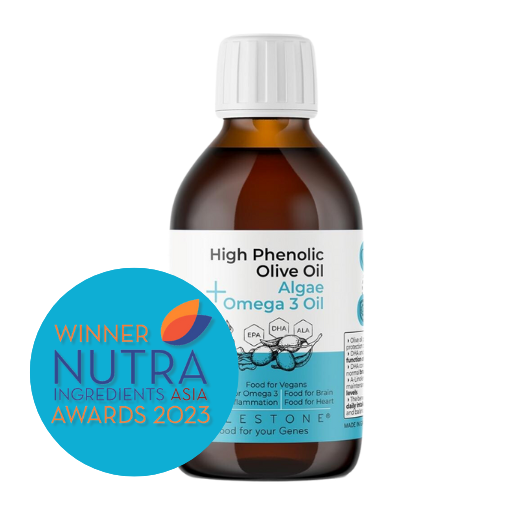
Delivered in an Olive Polyphenol Matrix
It’s the purity your body deserves for ultimate athletic endurance and recovery. Free of any chemicals and pesticides.


MILESTONE® vs. Fish Oils: A Clear Superiority
Did you know long-term use of certain oils can harm your liver? Recent research unveils that long-term consumption of sunflower or fish oils can damage the liver. In stark contrast, high-phenolic olive oil stands as a guardian, preserving liver health during aging. Make an informed choice – our omega-3-rich offerings are your ticket to a healthier life25.

100% Plant-Based
Is it plant-based and therefore suitable for vegans or vegetarians?
Rich in Natural Bioactives
Absorbed in less than an hour. Antioxidants play a major role for your health.
Vitamin E for Vegans
Natural vitamin E protects cells from the damage caused by free radicals
Free of Chemicals & Pesticides
Free of contaminants, heavy metals and pesticide residues that pass directly to your blood.
Liver Health
Does long-term consumption affect liver health?
Omega 3(ALA) 6 9
Does it contain a greater set of unsaturated fatty acids, such as ALA, linoleic, and oleic acid?
+ Omega-3s from Algae
Contains the most active EPA and DHA forms, necessary for brain, mood and cell health.
- Monteiro, Public Health Nutrition, 2019[↩]
- Lane, BMJ, 2024[↩]
- Fardet, European Journal of Nutrition, 2022[↩]
- Drewnowski, Journal of the American College of Nutrition, 2009[↩]
- Drewnowski & Fulgoni, Nutrition Reviews, 2008[↩]
- Manach, American Journal of Clinical Nutrition, 2004[↩][↩]
- Williamson, American Journal of Clinical Nutrition, 2005[↩][↩]
- Selma, Journal of Agricultural and Food Chemistry, 2009[↩]
- García-Villalba, Molecular Nutrition & Food Research, 2022[↩]
- Pedersen, Scand J Med Sci Sports, 2015[↩]
- Cowan, Arch Phys Med Rehabil, 2016[↩]
- Bull, Br J Sports Med, 2020[↩][↩][↩]
- Paluch, The Lancet Public Health, 2022[↩]
- Slavich, Nature Reviews Immunology, 2014[↩]
- Spiegel, The Lancet, 1999[↩]
- Twohig-Bennett, The Lancet Planetary Health, 2018[↩][↩]
- Drewnowski, J Am Coll Nutr, 2009[↩]
- Bull, Br J Sports Med, 2020[↩][↩]
- Slavich, Nat Rev Immunol, 2014[↩]
- Manach, Am J Clin Nutr, 2004[↩]
- Ordovas, BMJ, 2018[↩]
- Manach, Am J Clin Nutr, 2004[↩]
- Drewnowski, J Am Coll Nutr, 2009[↩]
- Slavich, Nat Rev Immunol, 2014[↩]
- Varela-Lopez A, Pérez-López MP, Ramirez-Tortosa CL, Battino M, Granados-Principal S, Ramirez-Tortosa MDC, Ochoa JJ, Vera-Ramirez L, Giampieri F, Quiles JL. Gene pathways associated with mitochondrial function, oxidative stress and telomere length are differentially expressed in the liver of rats fed lifelong on virgin olive, sunflower or fish oils. Journal of Nutritional Biochemistry. 2017 Sep 20; 52:36-44. doi: 10.1016/j.jnutbio.2017.09.007.[↩]