Polyphenols Are More Than Antioxidants
They Are Cell Messengers
by MILESTONE® Food for Your Genes
Polyphenol Supplement: Cellular Intelligence Beyond Antioxidant
Most people know polyphenols as “natural antioxidants.”
But what if that definition is just scratching the surface?
Polyphenols do more than neutralize free radicals. They talk to your cells — and your body listens.
A well-designed polyphenol supplement doesn’t just protect from oxidation. It can help regulate:
- Inflammatory pathways (like COX-2, NF-κB)
- Immune system balance
- Gene expression (via epigenetic modulation)
- Mitochondrial performance
They’re not passive protectors. They’re active biological messengers.
And when sourced correctly — as in a natural olive polyphenol supplement or a natural pomegranate polyphenol supplement — they work through multiple mechanisms, not just one.

How Polyphenols Influence Immunity, Inflammation & Gene Expression
At a cellular level, polyphenols interact with:
- Enzymes
- Receptors
- Transcription factors
- Immune regulators
Let’s look at just a few functions:
Gene Modulation
- Activate AMPK, sirtuins, and Nrf2 — linked to detox, mitochondrial biogenesis, and anti-aging3
Immunity
- Polyphenols support balanced immune modulation — not overactivation
- This makes them ideal for food-based immunity protocols, especially when delivered in a biofunctional matrix, like that of a high-quality polyphenol supplement
Polyphenols don’t just “fight inflammation.” They reprogram the signals that cause it.

Olive Oil Polyphenols
Oleocanthal & Hydroxytyrosol as Therapeutic Tools
Olive oil is often praised for being rich in monounsaturated fats — but what truly sets it apart are its polyphenols.
Two in particular:
- Oleocanthal – a compound with strong anti-inflammatory activity, comparable in action to ibuprofen4
- Hydroxytyrosol – one of the most potent natural antioxidants, shown to protect neurons, vascular endothelium, and mitochondria5
But what makes these compounds so unique isn’t just their antioxidant score — it’s their cellular precision.
They:
- Inhibit COX enzymes (inflammatory signaling)
- Improve oxidative resilience in immune and neural cells
- Regulate gene pathways tied to detoxification, immunity, and metabolism
And unlike synthetic antioxidants or isolated curcumin, these polyphenols occur naturally in synergy with a fatty acid matrix, making them:
- Highly bioavailable
- Less dependent on external absorption enhancers
- Perfect for a natural olive polyphenol supplement designed to work with — not against — the body

Pomegranate Polyphenols
Ellagitannins, Urolithins & Mitochondrial Health
Pomegranate isn’t just a source of vitamin C — it’s one of the richest plant sources of ellagitannins and punicalagins, two classes of polyphenols that undergo gut transformation into bioactive metabolites.
One of the most important of these?
💡 Urolithin A — a compound shown to:
- Trigger mitophagy (cellular recycling of damaged mitochondria)
- Improve muscle endurance and mitochondrial function
- Support glucose metabolism and immune regulation6, 2
What’s critical here is the role of the gut microbiome in unlocking these benefits:
- Without proper gut flora, ellagitannins may pass through unconverted
- But in a fermented or pre-digested polyphenol supplement, you bypass that risk
- That’s exactly the design philosophy behind your natural pomegranate polyphenol supplement line — microbiome-aware, mitochondria-targeted, clinically relevant
These aren’t just fruit extracts. They are precision molecules, transformed by biology, and delivered by design.
Gut Transformation
Why Polyphenol Function Depends on Microbiome Activity
Here’s something many polyphenol supplement users don’t know:
Polyphenols don’t always work in the form they’re consumed.
They become active through microbial transformation in the gut.
Take ellagitannins in pomegranate — they need to be metabolized into urolithins by certain gut bacteria to deliver their full mitochondrial and anti-inflammatory effects.
Take oleuropein in olive oil — it’s hydrolyzed into hydroxytyrosol during digestion, which then crosses the blood–brain barrier and modulates oxidative stress in neurons.
The quality of your gut microbiota affects:
- Which metabolites are produced
- How long they remain in the body
- Whether they even reach the target tissues at all
And this is why most off-the-shelf polyphenol supplements underperform:
- They provide generic extracts
- Ignore the gut–brain–immune axis
- Lack fermentation, prebiotic fibers, or delivery structures
Without the right conversion environment, even a high-dose polyphenol won’t act functionally.
This is why MILESTONE® focuses on:
- Fermented delivery systems
- Cold-pressed matrices
- Whole-food cofactors that support gut-mediated activation



The Synergistic Role of Polyphenols in Functional Supplementation
While individual polyphenols show promising results in labs, they rarely exist in isolation in nature.
And they work best when:
- Paired with other bioactives (like D3, B12, potassium)
- Delivered within a food-based matrix (not synthetic fillers)
- Supported by fat, fermentation, or fiber to improve uptake
Clinical synergy has been shown between:
- Ellagitannins + B vitamins for mitochondrial health and red blood cell support
- Hydroxytyrosol + Omega-3s for inflammation resolution
- Oleocanthal + D3 for immune modulation and mood balance
In fact, in one study:
- A food-formulated polyphenol supplement outperformed isolated polyphenol capsules in reducing inflammation markers by over 30% 7
This is the secret of biofunctional design:
You don’t just deliver nutrients — you deliver them in ways the body knows how to use.
That’s the MILESTONE® difference:
Every formulation is engineered with synergy in mind — not just dosage.
Why Polyphenol-Rich Oils Beat Standard Antioxidants
Most antioxidant supplements — even premium ones — are built on simplified chemistry:
- 💊 Isolated vitamin C (ascorbic acid)
- 💊 Generic flavonoids (like quercetin or EGCG)
- 💊 Lab-synthesized compounds, often in crystalline or powdered form
These offer limited value because they:
- Operate on a single antioxidant mechanism
- Require high doses to compensate for poor bioavailability
- Often lack synergy with other nutrients or fats
Polyphenols, especially those in olive oil and pomegranate, function differently:
They signal, not just shield.
- Oleocanthal doesn’t just neutralize free radicals — it actively modulates inflammation
- Hydroxytyrosol improves mitochondrial respiration and membrane integrity
- Urolithins (from ellagitannins) trigger mitophagy — a self-cleaning function that no synthetic antioxidant can replicate
They reach deeper systems.
Polyphenols cross biological barriers (blood-brain, gut lining), interact with the microbiome, and communicate with genes, enzymes, and hormones
This is why a truly effective antioxidant strategy must go beyond defense.
It must support cellular intelligence — and that’s what polyphenols are designed to do. 8, ((Wang, L., et al. Free Radic Biol Med, 2014)
What Makes a Polyphenol Supplement Biofunctional?
Not all polyphenol products are created equal.
In fact, most fall short for one of three reasons:
| Common Issues | MILESTONE® Approach |
|---|---|
| Low-quality plant source | Early harvest, verified origin (Greece) |
| Poor extraction method | Cold-press, water-based, or fermented |
| Inactive forms | Active precursors or microbiome-ready |
| No carrier oil or matrix | High phenolic olive oil matrix |
| Overprocessed or filler-loaded | Minimalist, food-grade formulation |
A true polyphenol supplement should:
- Be made from whole-food raw materials
- Retain their native bioactive structure
- Be tested for polyphenol concentration (mg/kg or mg/serving)
- Be delivered in a form the body can recognize, absorb, and use
Polyphenols are only as powerful as their delivery system — and that’s where most formulas fail.
MILESTONE® bridges this gap by combining:
- Clinical-grade olive oil
- Fermented pomegranate concentrates
- Food-matrix cofactors (D3, B12, potassium, etc.)
…to ensure every polyphenol is biologically active, not just chemically present.
How MILESTONE® Delivers Polyphenols That Actually Work
Anyone can claim their product contains “plant polyphenols.”
But very few deliver them in a way that the body can truly absorb, convert, and activate.
MILESTONE® is built on food-sourced polyphenols with biological purpose, not just chemical presence.
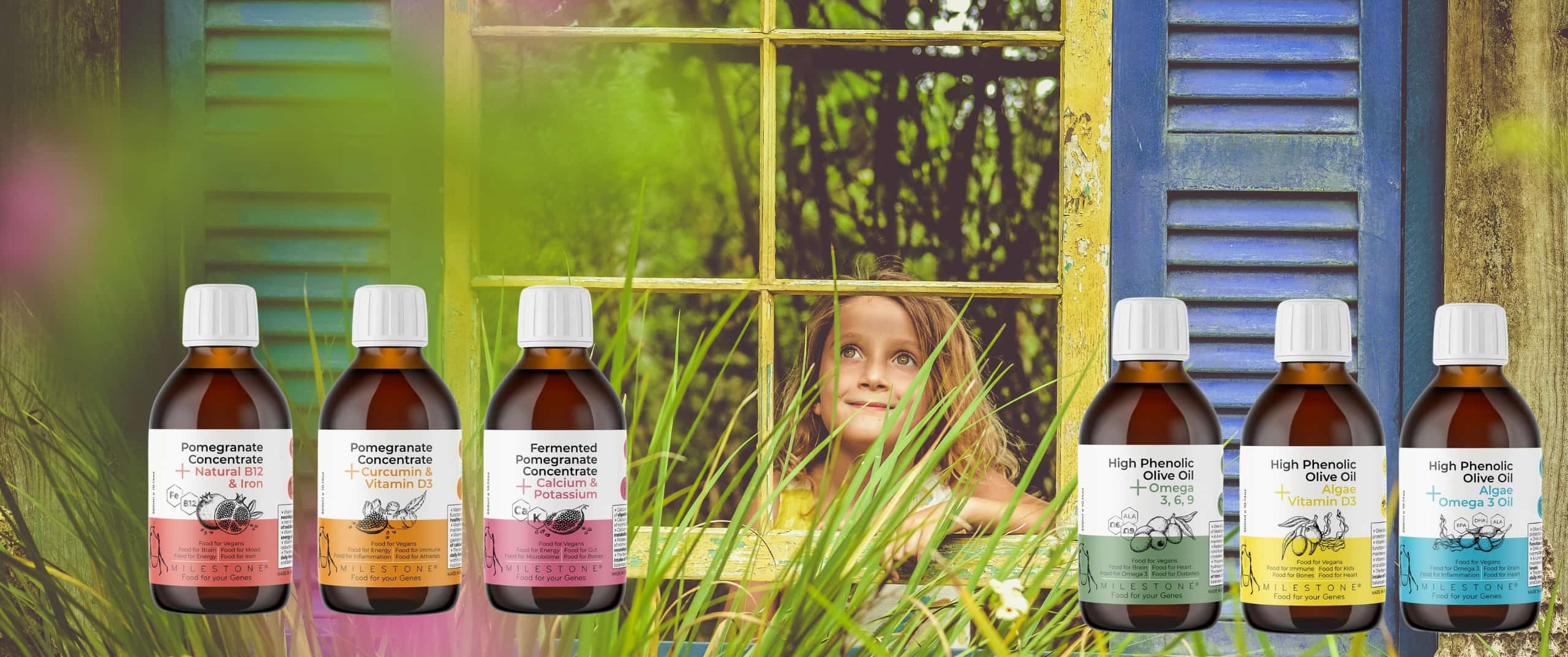
Pomegranate Curcumin + Micellized D3
Ellagitannins from fermented pomegranate concentrate, paired with turmeric extract and advanced micellized vitamin D3 — built for mitochondrial health, mood, and inflammation support.
View product →
Pomegranate + Vitamin B12
A microbiome-friendly, fermented polyphenol formula designed to support red blood cell production, brain function, and endurance — thanks to urolithin-generating ellagitannins.
View product →
High Phenolic Olive Oil with Polyphenols (Omega 6-9)
One of the few globally available oils independently verified to contain over 1000 mg/kg of active polyphenols, including oleocanthal and hydroxytyrosol. Supports cognitive, metabolic, and immune health.
View product →
These aren’t extracts. They’re clinical-grade, whole food–based tools — backed by precision sourcing and scientific logic.
FAQs
Are polyphenols just a type of antioxidant?
No. While they have antioxidant properties, polyphenols act as signaling molecules that affect inflammation, gene expression, immune balance, and even mitochondrial function.
What are the benefits of olive oil polyphenols?
Olive oil polyphenols like oleocanthal and hydroxytyrosol reduce inflammation, protect vascular health, and support immune modulation — especially when delivered in high phenolic concentrations.
How do pomegranate polyphenols support gut and mitochondria?
Ellagitannins in pomegranate are converted by gut bacteria into urolithins — compounds that stimulate mitochondrial renewal, improve muscle endurance, and regulate inflammation.
What makes a polyphenol supplement effective?
It must be sourced from active foods, retain its native structure, contain bioavailable forms (like urolithins or hydroxytyrosol), and be delivered in a supportive matrix — like fermented concentrate or polyphenol-rich olive oil.
Conclusion: Polyphenols Are the Language of Real Health
They’re not just plant pigments.
They’re not just antioxidants.
They’re intelligent, adaptive molecules that speak your body’s language.
And when delivered as part of a true polyphenol supplement — crafted from fermented fruits, early-harvest olives, and nutrient-rich carriers — they don’t just sit in your bloodstream.
They signal, regulate, and restore.
This is the future of real supplementation.
Not synthetic mega-doses — but nature’s most advanced messengers, reintroduced with clinical precision.
A Word From MILESTONE®
MILESTONE® Food for your Genes uses only high-quality sources, including peer-reviewed studies, to support the facts within our articles. Read our editorial process to learn more about how we fact-check and keep our content accurate, reliable, and trustworthy.
Of Dreams and Knowledge – All rights reserved. This article and all associated content are the intellectual property of MILESTONE® and may not be copied, republished, or redistributed without written permission.
Disclaimer: The information provided here is for educational purposes only and is not intended to diagnose, treat, cure, or prevent any disease. Always consult with a qualified healthcare provider before making any changes to your diet, supplementation, or health routine.
Related Articles


- Parkinson & Keast, 2006[↩]
- González-Sarrías, A., et al. <a href=”https://doi.org/10.1016/j.jnutbio.2015.09.006″ target=”_blank”>Journal of Nutritional Biochemistry, 2015</a>[↩][↩]
- Zrelli, H., et al. <a href=”https://doi.org/10.1016/j.freeradbiomed.2011.07.013″ target=”_blank”>Free Radical Biology and Medicine, 2011</a>[↩]
- Beauchamp, G.K., et al. <a href=”https://doi.org/10.1038/437045a” target=”_blank”>Nature, 2005</a>[↩]
- Visioli, F., et al. <a href=”https://doi.org/10.1093/jn/130.11.2995S” target=”_blank”>Journal of Nutrition, 2000</a>[↩]
- Andreux, P.A., et al. <a href=”https://doi.org/10.1038/s41591-019-0405-0″ target=”_blank”>Nature Medicine, 2019</a>[↩]
- Fito, M., et al. <a href=”https://doi.org/10.1161/CIRCULATIONAHA.105.603308″ target=”_blank”>Circulation, 2007</a>[↩]
- Lucas, L., et al. Journal of Nutritional Biochemistry, 2011[↩]